
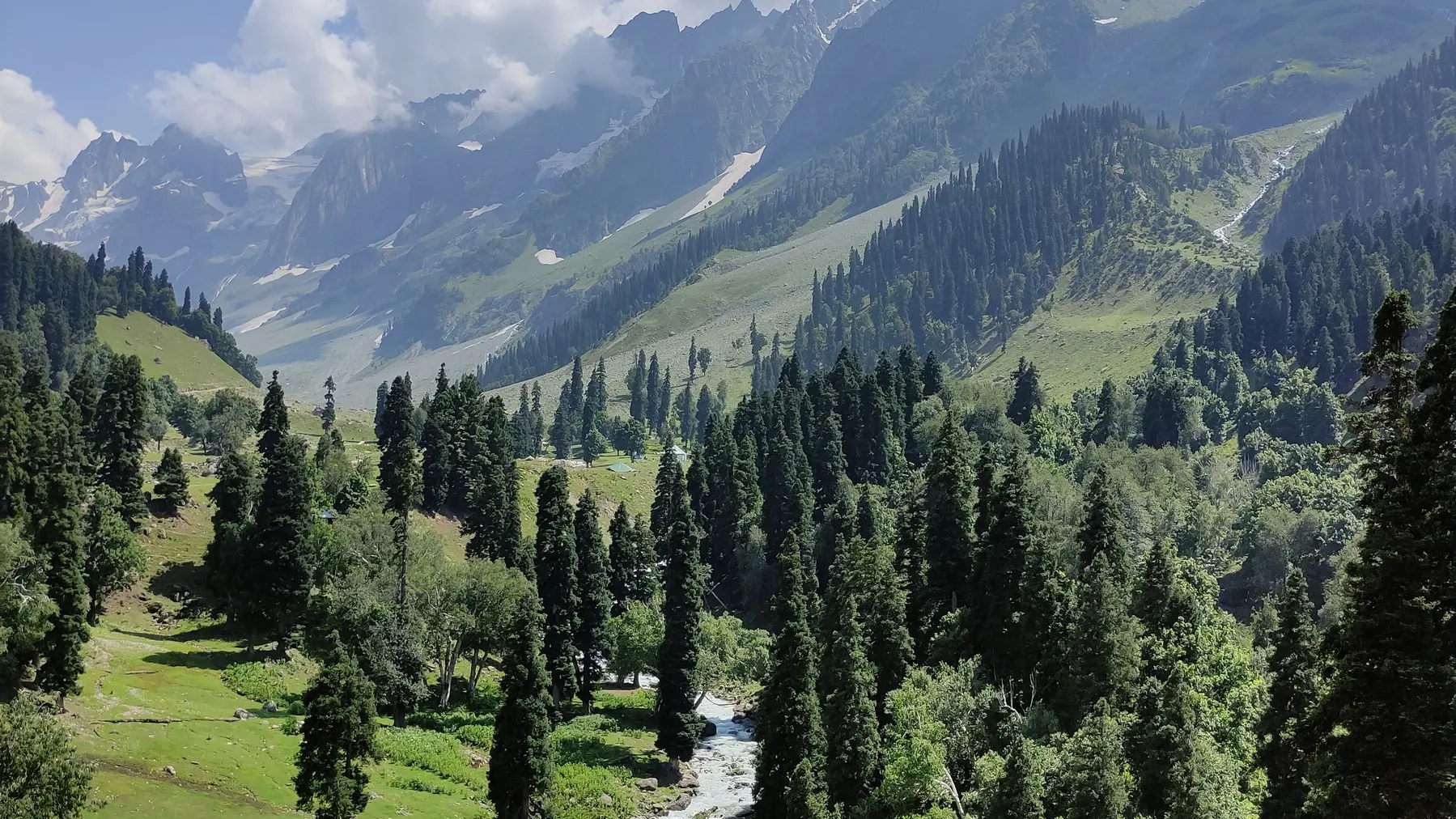
The Trees of KashmirKashmiri and English Names
Kashmir mountain forest and stream. Photo: Shahid Sultan / Pexels.
A quick guide to the trees of Kashmir
| Kashmiri name | English name | Botanical name |
|---|---|---|
| Booen | Chinar / Oriental plane | Platanus orientalis |
| Doon / Doon Kul | Common or Persian walnut | Juglans regia |
| Divdhor | Deodar / Himalayan cedar | Cedrus deodara |
| Kaayur / Yaari Kul | Himalayan blue pine | Pinus wallichiana |
| Veer | Willow | Salix species |
| Fraes’t | Poplar | Populus species |
| Burza | Himalayan birch | Betula utilis |
| Budul | Himalayan silver fir | Abies pindrow |
| Tuel Kul | Mulberry | Morus alba |
| Bremij / Brimij | Caucasian hackberry | Celtis caucasica |
| Brenn | Elm | Ulmus species; local identification varies |
| Hatab | False witch hazel | Parrotiopsis jacquemontiana |
| Sarva Kul | Cypress | Cupressus species |
| Kikkar | Acacia-type thorn tree | Identification varies by local usage |
Kashmir’s trees are more than scenery. They shade village paths, hold riverbanks together, warm homes through winter and provide the wood behind some of the Valley’s most recognisable crafts. Their Kashmiri names also carry memories: of willow groves, walnut workshops, birch bark, pine kindling and the changing colour of a chinar leaf.
This guide brings together commonly used Kashmiri, English and botanical names for the trees most closely associated with Kashmir. Spellings can change from one district or family to another, and some traditional names describe a useful kind of tree rather than one exact botanical species. Where identification is uncertain, we have said so.
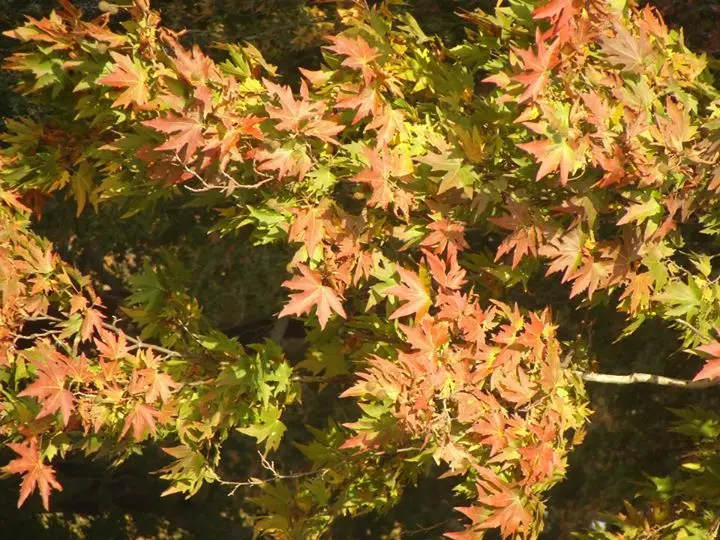
Chinar — Booen — Platanus orientalis
Few trees are as closely tied to the image of Kashmir as the chinar. Its broad, hand-shaped leaves make deep shade in summer and turn copper, crimson and gold in autumn. Old chinars stand in gardens, courtyards and public spaces, often becoming landmarks in their own right.
The Kashmiri name Booen carries an immediate sense of place. A mature chinar is not simply a decorative tree: it can be a meeting point, a shelter and a living witness to generations of everyday life. Botanically, the chinar is the Oriental plane, Platanus orientalis.
Walnut — Doon or Doon Kul — Juglans regia
Walnut belongs at the heart of any account of Kashmir’s trees. Known as Doon or Doon Kul, the common or Persian walnut produces food, shade and one of the Valley’s most valued timbers. Its wood has a warm brown colour, fine grain and enough strength for detailed carving.
Kashmiri walnut carving can be seen in furniture, boxes, trays, screens and architectural panels. Craftspeople value the way seasoned walnut can hold fine floral and geometric detail without losing its quiet, natural character. It is a material that rewards patience: the tree grows slowly, the timber must be dried carefully, and the finished object is made to last.
At Koshur Chaan, that respect for material guides our own approach to solid-wood cutting and serving boards: understand the grain, remove only what is needed and let the wood remain the main feature.
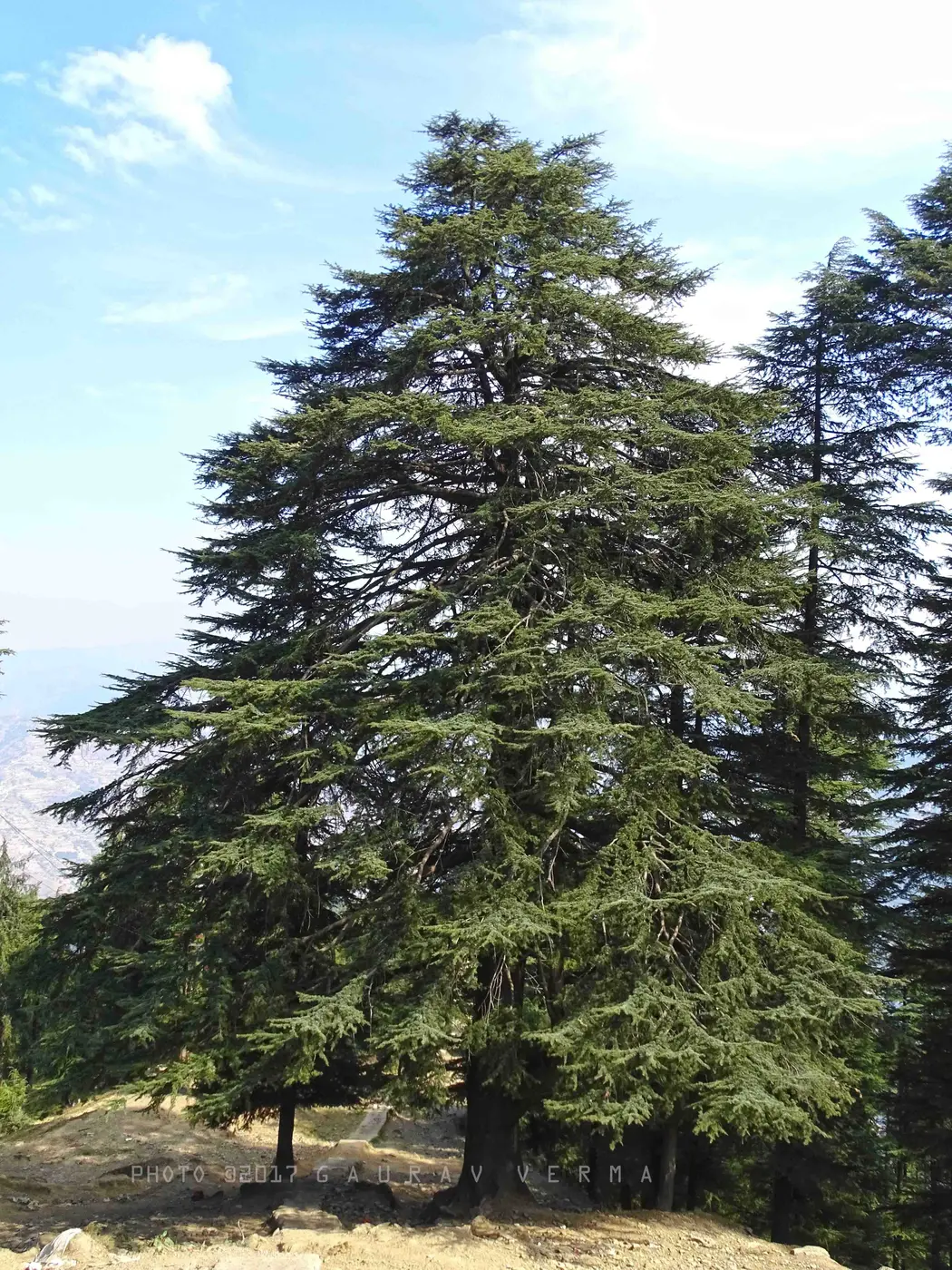
Deodar — Divdhor — Cedrus deodara
Deodar is the great Himalayan cedar. Tall, evergreen and fragrant, it grows naturally across the western Himalaya. Its English name comes from the Sanskrit idea of the “wood of the gods,” while the Kashmiri name is often written as Divdhor.
Deodar timber has long been valued for building because it is strong, workable and naturally durable. In the landscape, its layered branches and gently drooping tips give it a calm, unmistakable outline. Old buildings, bridges and household objects all reflect the practical knowledge people developed around this tree.
Himalayan blue pine — Kaayur or Yaari Kul — Pinus wallichiana
The Himalayan blue pine has long, soft needles with a blue-green cast and slender cones. In Kashmiri it is known as Kaayur or Yaari Kul. Its resin-rich splinters, called laesh, were traditionally prized as quick kindling, especially when a fire had to be coaxed into life on a cold morning.
Kaashur yaar guv kaayur naar.
The fire of the pine is the Kashmiri’s friend.
The saying is simple, but it records a close relationship between tree, weather and home. Pine offered timber and fuel, yet its place in memory comes just as much from warmth, scent and the familiar crackle of a winter fire.
Willow — Veer — Salix species
Willow thrives beside water and in damp ground, so it feels at home along Kashmir’s rivers, lakes and field edges. Veer is the Kashmiri name, while a willow grove may be called a veer-vaar.
The tree has supported many parts of rural life. Flexible willow shoots can be woven, while larger wood has everyday uses. Dried willow leaves, known as baatchhi, have traditionally been stored as winter fodder. Willow is also part of Kashmir’s sporting story because selected willow wood is used for cricket bats, although the best-known bat willow is a particular cultivated type rather than every willow seen beside a stream.
Poplar — Fraes’t — Populus species
Rows of poplars create some of the Valley’s most recognisable lines in the landscape. Fast-growing and upright, they have been planted around fields, homes and roads for shade, shelter and timber. The Kashmiri name is commonly written as Fraes’t.
Yohuy chhukh fraes’t hue.
You are as tall as a poplar.
The comparison shows how easily the shape of a tree enters daily speech. Several poplar species and cultivated forms occur in Kashmir, so the botanical label is best kept at the genus level unless a particular tree has been identified.
Himalayan birch — Burza — Betula utilis
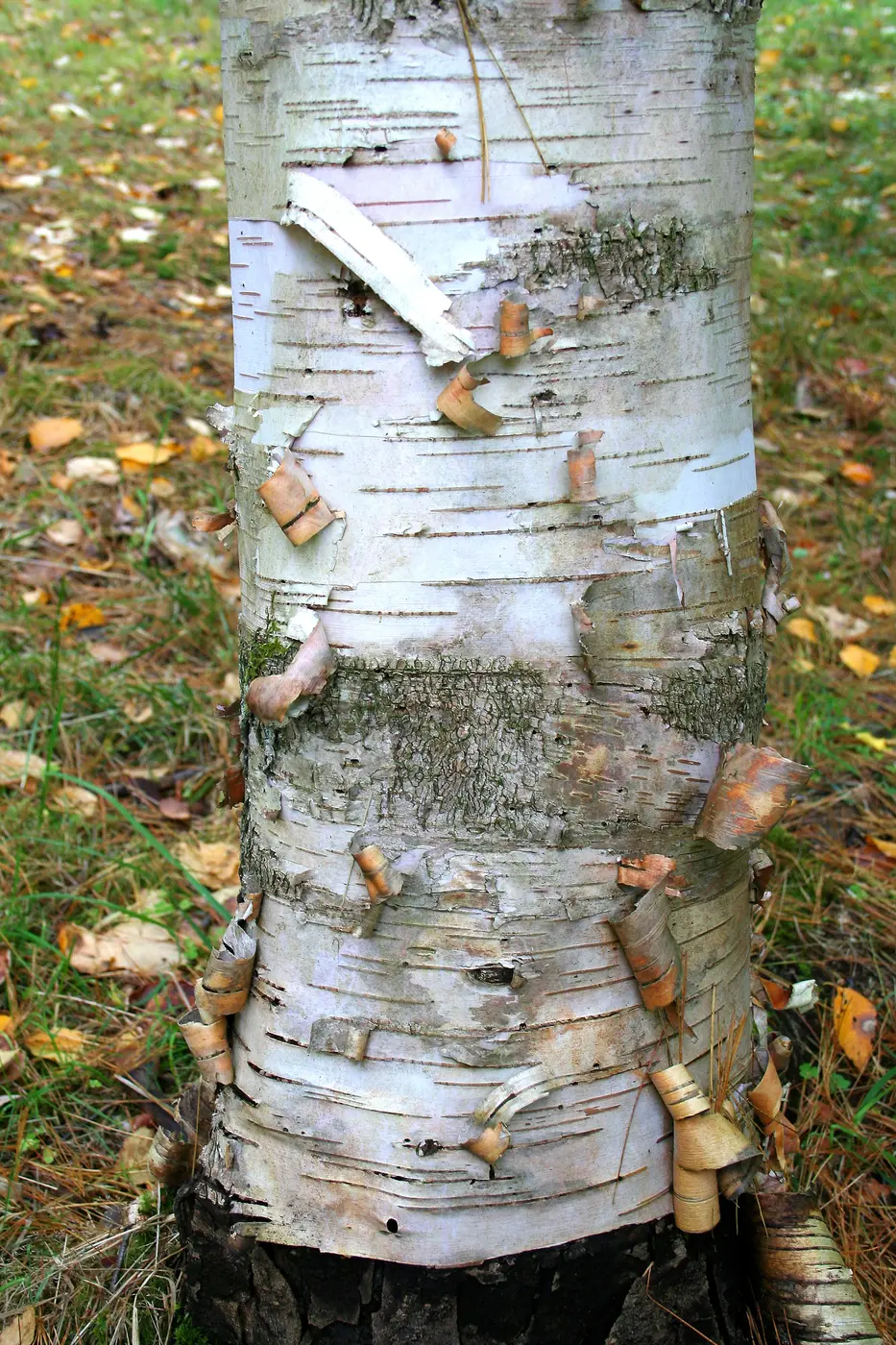
High in the mountains, near the upper limit of tree growth, Himalayan birch forms pale, weathered stands. Its thin bark peels in papery layers. Known as Burza, this bark was historically used as a writing surface, giving the tree a special connection to manuscripts, memory and learning.
Birch survives where conditions are hard and the growing season is short. That makes it ecologically important as well as culturally memorable. It protects fragile mountain ground and creates habitat at the edge between forest and alpine landscape.
Burzahom: the “place of birch”
The connection between birch and Kashmiri history also appears in the name Burzahom, the major prehistoric settlement near Srinagar. The Directorate of Tourism Kashmir explains the name as “place of birch,” referring to birch trees that once dominated the area. Excavations there revealed Neolithic pit dwellings, stone and bone tools, pottery and traces of a community adapting closely to its landscape.
This does not tell us that every wooden object at Burzahom was made from birch, but it does show how strongly a tree can become part of a place name and its memory. The site gives the Burza story a much deeper time scale: Kashmir’s relationship with trees reaches beyond craft and folklore into the language of its earliest known settlements.
Himalayan silver fir — Budul — Abies pindrow
Budul, the Himalayan silver fir, belongs to the cool, moist forests of the western Himalaya. It is a tall evergreen with dark needles and a straight trunk. In mixed mountain forests it grows alongside deodar, pine and broad-leaved trees, helping create the deep green canopy associated with higher elevations.
Mulberry — Tuel Kul — Morus alba
Mulberry, or Tuel Kul, is a generous village and garden tree. Its fruit is eaten fresh, while its leaves are closely connected with silkworm rearing. The tree therefore sits at the meeting point of food, shade and traditional cottage work.
Bremij or Brimij — Caucasian hackberry — Celtis caucasica
Bremij or Brimij is generally identified today with the Caucasian hackberry, Celtis caucasica, though older records may use the name Celtis australis. This is a good example of why local plant names need a little care: oral knowledge can remain steady while scientific naming and identification change over time.
Elm — Brenn — Ulmus species
The Kashmiri name Brenn refers to elm, but the exact species can vary by source and locality. Elm wood is tough and was useful for objects expected to take wear. The phrase “Yohaai chhukh brenn mond hue” compares someone to a great elm log: solid, large and difficult to ignore.
Hatab — false witch hazel — Parrotiopsis jacquemontiana
Hatab is usually a large shrub or small tree rather than a forest giant. Its hard wood has been used for tool handles and household implements. A traditional pestle made from Hatab may be called a muhul, paired with a wooden mortar known as a kunz, often associated with deodar.
Cypress — Sarva Kul
Sarva Kul is the Kashmiri name used for cypress. Its narrow evergreen form brings height and rhythm to gardens and formal landscapes. Because more than one cypress may be cultivated, the exact botanical name depends on the individual tree.
Kikkar and the importance of local context
Kikkar is widely used for a thorny acacia-type tree, but the name does not always point to one species in every place. It may refer to trees placed in Acacia, Vachellia or related groups. It is more honest to keep the identification broad unless leaves, flowers, pods and location can all be checked.
Sweet chestnut and horse chestnut are not the same tree
These two names are easily confused. Sweet chestnut belongs to the genus Castanea and produces edible nuts when properly prepared. Horse chestnut belongs to Aesculus; its conkers are not edible. Their leaves, flowers and fruits are different, so a photograph or local name alone should not be used to decide which one is present.
Trees as a Kashmiri archive
A landscape can be read like an archive. Chinar records the seasons in colour. Walnut holds the marks of a carver’s hand. Willow remembers water and woven work. Birch carries the idea of the written page. Pine recalls winter fire, while deodar stands for strength and shelter.
Keeping these names alive matters because language preserves details that a simple species list cannot. A word such as veer-vaar, baatchhi or laesh tells us not only what a tree is, but how people lived with it. That practical, local knowledge deserves the same care as the objects made from the wood.
If a name in your family or district is spelled differently, that is part of the story. Kashmiri words move between scripts and English transliterations, so several spellings can be valid. We welcome thoughtful corrections and memories that help make this living guide richer.
Further reading and image credits
- Plants of the World Online, Royal Botanic Gardens, Kew, for accepted botanical names and native ranges.
- Jammu & Kashmir Department of Wildlife Protection, for the region’s habitats and forest life.
- European Commission Joint Research Centre, for information on common walnut and its wood.
- Chinar photograph: Vinodtiwari2608, Wikimedia Commons, CC BY-SA 4.0.
- Deodar photograph: Gv3101992, Wikimedia Commons, Creative Commons license.
- Himalayan birch photograph: Jean-Pol GRANDMONT, Wikimedia Commons, CC BY-SA 3.0.
Names note: Kashmiri spellings vary by dialect, district and transliteration. Some folk names cover more than one related species. This article uses cautious identifications and will be updated as stronger local botanical references become available.

@wosta ❤️
Follow @koshurchaan on Instagram