
A Kashmiri reflection
What Are We Doing to Our Own Name?
Saffron is not simply a product in Kashmir. It is labor, landscape, prayer, harvest, family memory and pride. That is why it hurts when a small number of people treat its name as something to borrow, dilute or sell without protecting.
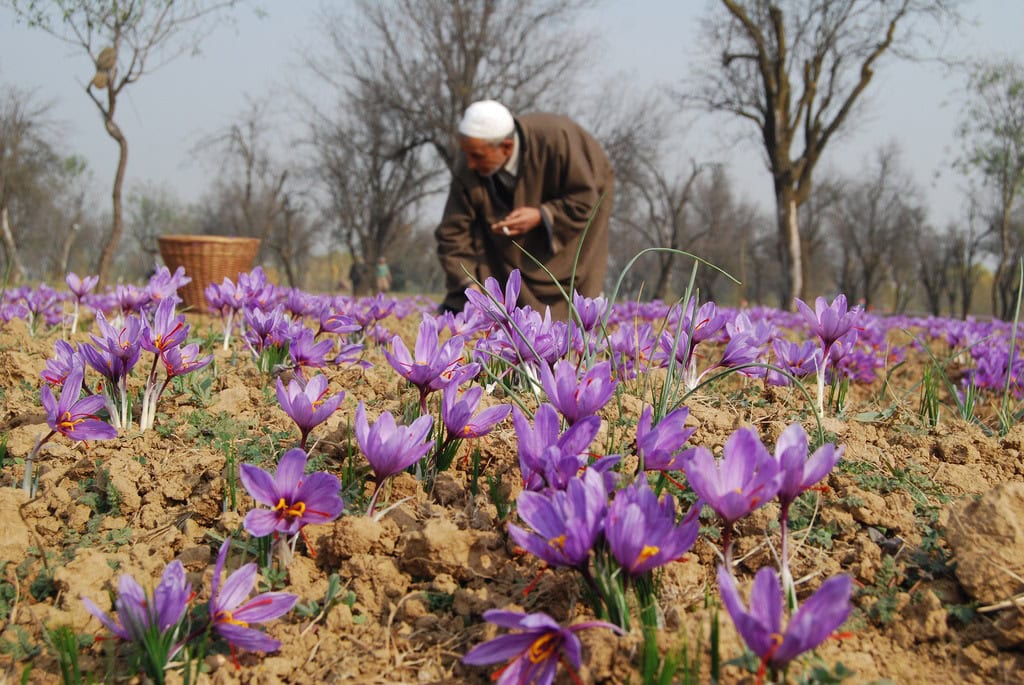
When trust breaks, opportunity leaves
I know someone who bought saffron hoping to start a small, proud business around an authentic Kashmiri product. The idea was simple: tell the story honestly, build trust slowly, and introduce customers to something beautiful from home.
But when they had the samples tested, the results showed the saffron had been mixed with Iranian saffron. What had been supplied did not match what had been promised.
The plan did not grow. Confidence was damaged before it had a chance. A young business was lost, and with it, a little more of the world’s trust in Kashmiri saffron.
This is the part we do not always talk about: a dishonest batch does not only hurt the person who buys it. It hurts every honest farmer, every family that has grown saffron for generations, and the name of Kashmir itself. It can close the door on a future business, a future customer, and a future advocate for Kashmir.
Two stories of arrival
One much-loved local Sufi tradition tells of Khwaja Masood Wali and Sheikh Sharief-ud-Din Wali. In the story, hospitality offered during illness is repaid with a saffron corm and the knowledge to grow it. A shrine in Pampore is associated with the saints. It is a story held with affection, rather than a date-stamped record.
A second stream of local and textual interpretation places saffron in Kashmir much earlier. Kalhana’s Rajatarangini and later Mughal descriptions, including the Ain-i-Akbari, are often mentioned in these accounts. The precise route and date of the crop’s first arrival remain debated; what is clear is how deeply it has become woven into Kashmir’s cultural memory.
Pampore and the saffron landscape
Pampore, in Pulwama district southeast of Srinagar, is widely known as Kashmir’s saffron country. The surrounding plateau villages—often named as Ladhoo, Khrew, Dusso and Konibal—form the heart of that landscape. Smaller areas of cultivation are also associated with parts of Budgam, Srinagar and Kishtwar.
This geography matters because saffron is not only a red thread in a jar. It is a relationship between a place, a season and the people who know how to work with both.
Karewa, or Wudar: a particular ground
The Pampore fields sit on the elevated Karewa plateaus, locally called Wudar. These ancient sedimentary formations are often described as the remains of an old lake landscape. Their silty, calcareous soils can drain quickly while holding enough moisture below the surface—conditions growers value because saffron corms dislike standing water.
At roughly 1,600 metres above sea level, the fields experience strong light, warm dry summers and a crisp shift into autumn. That change of season helps set the rhythm for flowering, usually in the brief purple bloom of October and early November.
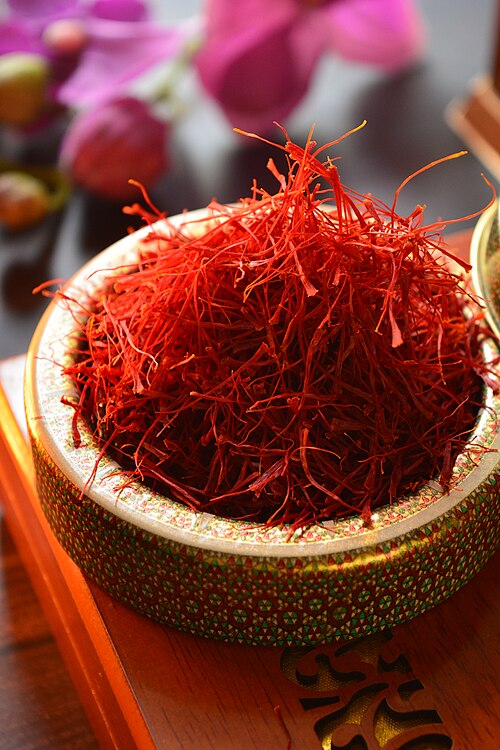
Why the season shows up in the thread
Saffron’s colour, aroma and taste are linked to naturally occurring compounds: crocin contributes colour, safranal is associated with aroma, and picrocrocin with its characteristic bittersweet flavour. Their expression is shaped by the crop’s genetics, growing conditions, harvesting and handling—not by a single magic claim about one place.
That is why careful cultivation and honest grading matter. Terms such as Mogra—long, deep-red stigmas with little or no yellow style—and Lacha—stigmas retaining some yellow style—help describe the form of the product. They should clarify what a buyer is receiving, never become a disguise for it.
A protected name needs protected practice
Kashmir saffron has Geographical Indication recognition. That recognition has meaning only when the traceability, labeling and selling behind it are as careful as the cultivation itself.
A name built slowly
Kashmiri saffron carries a reputation that took generations to build. Its value is not just in its color, fragrance or use in a kitchen. It comes from the patience of cultivation, the care of picking each flower, the separating of delicate stigmas and the knowledge that a harvest can be affected by weather, water, labor and time.
People buy it because they believe they are receiving something special and real. When they offer it as a gift, place it in food or build a small business around it, they are trusting the name Kashmir as much as the seller in front of them.
The wound is not only financial
There is nothing wrong with Iranian saffron. It has its own growers, history and market. The wrong begins when saffron of one origin or quality is presented as something else—or when it is blended, substituted or misrepresented under the Kashmiri name.
A person may make a quick sale that way. But the loss spreads much further. The customer feels cheated. The next buyer becomes suspicious. The honest farmer, packer and small seller have to work twice as hard to prove themselves. A name that took centuries to earn can be injured by a handful of shortcuts.
“When we sell a name we have not protected, we are not only cheating a buyer. We are spending the inheritance of those who come after us.”
This is not a condemnation of everyone
Many Kashmiri growers and sellers protect their product with real integrity. They know the work behind each gram. They understand that traceability, transparent sourcing, honest labeling and proper testing are not burdens placed on tradition; they are ways of defending it.
The point is not to shame the whole community for the choices of a few. The point is to refuse to become numb to those choices. Love for a tradition should make us more honest about what threatens it, not less.
What protecting the future looks like
It looks like telling buyers clearly what they are purchasing. It looks like separating different origins instead of hiding them. It looks like batch records, sensible testing, responsible packaging and prices that respect the people doing the real work. It looks like refusing a sale when the story behind the product is not clean.
Most of all, it looks like remembering that reputation is a shared asset. Every honest sale strengthens it. Every deceptive one weakens it. We cannot ask the world to value Kashmiri saffron while quietly allowing the name to be used carelessly.
The future deserves better than a quick profit.
Kashmir has given the world a product of remarkable beauty. Let us protect it with the same care that goes into growing it. The next generation should inherit a name that opens doors—not one they have to spend their lives trying to repair.
— Wosta.
Follow @koshurchaan on Instagram
I hold my own work to the same rule: say plainly what something is, where it comes from, and how it was made. See the boards I make in Johns Creek.